
Brookline Wood Flooring handles hardwood floor repair in Brookline, MA, serving surrounding cities including Jamaica Plain, Forest Hills, West Roxbury, Watertown and Back Bay. For 20+ years we have replaced damaged boards with matched wood, fixed squeaks and loose fasteners, closed gaps, removed pet-stained sections and repaired floors damaged by insects. Our starting point is always the same: keep as much of the original floor as possible.
That approach fits the homes here. Much of the housing stock around Brookline dates from before 1940, with original red oak, white oak, maple and pine floors that were milled better than most new flooring. When a section is damaged, tearing out the room is rarely necessary. A careful weave-in repair with matched boards, followed by refinishing, can make the damage disappear.
Repairs also tend to reveal the cause of the damage. A stained board may point to a leaking radiator, a soft area to rot, a squeak to a subfloor that has pulled away from its joists. We find and fix the cause first, because a repaired board over an unfixed problem just fails again.
Repairing Damaged Boards
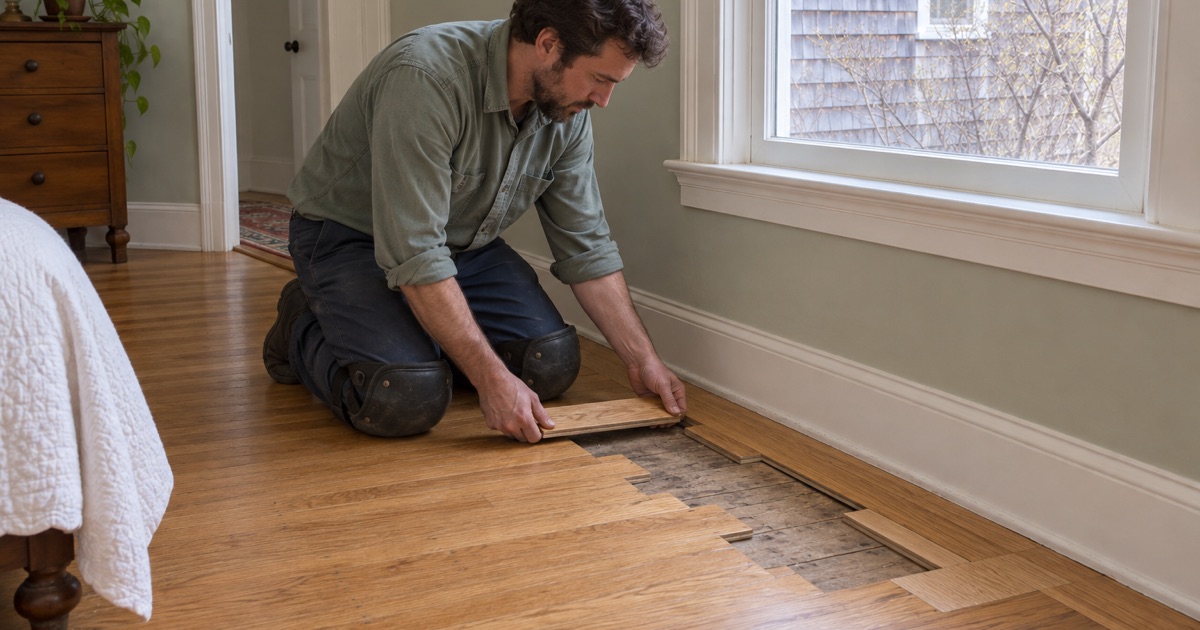
Board Replacement and Weave-In Repair
A weave-in repair removes damaged boards one by one, cutting each at a staggered point so the new boards interlock with the old rather than meeting in a straight line. The replacement boards match the original species, width and cut, and they are fastened with the same kind of cleats or nails as the floor around them. After sanding, the repair reads as part of the original floor.
The method works for a single cracked board, a damaged strip along a wall or a large area after a partition wall has been removed. It is the core of nearly every repair we do.
Pet Urine Stains and Black Marks
Pet urine soaks into oak and reacts with the tannins in the wood, turning it black. Those pet urine stains usually run too deep to sand out, and bleaching rarely clears them evenly. Replacing the affected boards with matched wood is the reliable fix, followed by refinishing so the new boards blend in.
Plant pots and other long-standing water sources leave similar black marks. We test each stain before quoting, since lighter gray water stains often sand out and do not need new boards at all.
Cracked, Split and Gouged Boards
Boards split along the grain when they dry out, take a heavy impact or were nailed too close to the edge. A deep gouge from a dropped appliance or a dragged dresser goes past what a sanding can remove. Small cracks can be filled, but a board with a long split or a broken tongue is best replaced so it stops moving under foot.
Fixing Squeaks, Gaps and Loose Boards
Squeaks and Loose Flooring Cleats
Most squeaks come from boards rubbing against loose nails or flooring cleats, or from a plank subfloor rubbing against the joists as someone walks. Older floors fastened with cut nails loosen as the wood shrinks and swells over decades. We refasten from above with small trim screws countersunk and filled, or from below with shims and screws when the ceiling underneath is open.
We also check that the squeak is not a sign of something bigger. A joist that has cracked or been notched for plumbing needs a carpenter before the floor is refastened.
Hollow Spots and Soft Areas
Hollow spots, where a board sounds empty under foot, mean the flooring has separated from what is beneath it. On nail-down floors the fasteners have loosened; on glue-down floors the adhesive has let go. A soft area that gives under weight is more serious and can mean rotted subfloor or water damage below.
We open soft areas to see what is underneath before repairing them. Rotted subfloor is replaced and the new flooring woven back in so the surface looks unchanged.
Board Gapping and Winter Gaps
Board gapping is common in older homes with radiator heat, where dry air during the long heating season shrinks solid hardwood. Winter gaps that close again by summer are normal wood movement and are best left unfilled. Permanent gaps, often in old pine, can be filled with thin slivers of matching wood glued into the joint.
Wood filler in a seasonal gap cracks out within a year, so we identify which kind of gap you have before choosing a fix. Watching the same gaps through a heating season is often the surest test.
Insect Damage in Older Floors
Powderpost Beetle Damage
Powderpost beetles lay eggs in wood, and the larvae tunnel through it for years before emerging through small round holes and leaving fine, flour-like powder behind. They favor older hardwood and softwood, especially in damp spaces. Fresh powder beneath holes means the activity is live and needs a pest professional first.
Once the infestation is treated, we replace boards that have lost their strength and fill scattered exit holes in sound boards. Reducing moisture in the space helps keep the beetles from returning.
Carpenter Ants and Moisture-Damaged Wood
Carpenter ants do not eat wood; they hollow it out to nest, and they strongly prefer wood that is already damp or decaying. Finding them in a floor almost always points to a leak, a damp sill or a wet crawlspace. We work with your pest professional to repair the damage and point out the moisture source so the repair lasts.
Repairs in Old Houses and Condos
Matching Antique Pine and Quartersawn Oak
Older homes around Brookline have floors that are hard to buy new: wide plank pine, heart pine and quartersawn white oak with a flecked grain. We match them with the closest available stock, often reclaimed boards of the same age and width. When a matching board cannot be found, we borrow boards from a closet or under a built-in and put new wood in the hidden spot.
Patching Radiator Footprints and Pipe Holes
When a steam radiator is removed or moved, it leaves pipe holes, an unfinished rectangle and sometimes stained boards from years of slow leaks. We plug small holes, replace stained and soft boards and weave the patch into the floor so the footprint disappears after refinishing.
Painted and Lead-Era Floors
In homes built before 1978, painted floor borders and nearby baseboards may contain lead. Massachusetts runs its own lead-safe renovation rules, and repairs that disturb painted surfaces are set up lead-safe from the start. We confirm the build year and look for paint before cutting or sanding anything.
Our Step-by-Step Hardwood Floor Repair Process
Step 1: Find the Cause
We inspect the damaged area, test stains, read moisture levels and check from below when possible to learn why the floor failed. A repair only lasts once that cause is fixed.
Step 2: Source Matching Wood
We identify the species, width and cut, and locate new or reclaimed boards that match the original floor. For rare widths we may borrow boards from a closet and fill the closet instead.
Step 3: Cut Out and Weave In
Damaged boards come out at staggered points, the subfloor is repaired if needed, and matching boards are woven in and fastened. Each new board is set tight so it sands level with its neighbors.
Step 4: Sand and Finish to Blend
The repaired area is sanded and finished, often with the surrounding floor, so the repair matches in color and sheen. We tell you up front if a spot repair alone will show.
- 20+ Years on Wood Floors
- Free In-Home Estimates
- Dust-Contained Sanding