
Brookline Wood Flooring handles hardwood floor water damage in Brookline, MA, serving surrounding cities including Jamaica Plain, Forest Hills, West Roxbury, Watertown and Back Bay. With 20+ years on wood floors, we trace the leak, dry the boards and read them with a moisture meter, then decide what can be saved before anything is torn out. When a claim is involved, we document the damage room by room for the adjuster.
Water damage to a hardwood floor is rarely as bad as it first looks, and rarely as simple. Boards that cup after a leak often flatten again as they dry, while a stain that looked minor can reach deep into the wood. Older homes add their own sources: steam radiators that leak slowly for years, upstairs units in condo buildings and basements that take on water in spring.
The mistakes that cost owners the most are made in the first days: sanding a cupped floor before it dries, tearing out boards that would have recovered, or covering a floor that is still wet. We slow that down to the right pace, measure first, and give you a written plan for drying, repair and refinishing.
What Water Does to a Hardwood Floor
Cupping and Crowning
Cupping happens when the bottom of a board takes on more moisture than the top, so the edges rise above the center. It usually means water came from below or soaked into the subfloor. Crowning is the reverse, with the center higher than the edges, and it often follows a cupped floor that was sanded before it dried.
Both are signs of moisture imbalance rather than permanent damage in themselves. Once the moisture is corrected and the floor dries, many cupped floors flatten enough to be sanded smooth and refinished.
Buckling and Lifted Boards
Buckling is the most severe response to water: boards swell so much that they push against each other and lift off the subfloor, sometimes by several inches. It can also happen when a floor was installed without enough expansion gap at the walls. Buckled boards may pull their fasteners loose or crack their tongues.
Some buckled floors settle back down after drying and can be refastened. Boards that are cracked, split or permanently deformed need replacement with matched wood.
Water Stains and Black Boards
White or gray water stains usually sit in the finish or the very top of the wood and often come out with sanding. Black stains mean water sat in the wood long enough to react with its tannins, which is common in oak near radiators, plants and pet areas. Those stains run deep and generally call for board replacement.
A musty smell or dark spotting at board edges can point to mold in the subfloor. We check below the surface when we see either.
Where the Water Comes From
Steam Radiator Leaks
Steam radiators leak at their valves and air vents, often a few drops at a time, soaking the boards around their feet for years before anyone notices. The result is a ring of black stains, soft boards and sometimes rot in the subfloor below. Radiator leaks are among the most common reasons we are called to older homes around Brookline.
The radiator valve or vent has to be repaired first, usually by a plumber or heating technician. We then remove the damaged boards, repair the subfloor and weave in matched wood.
Leaks From the Unit Above
In condo and apartment buildings, water often comes from the unit upstairs: an overflowing tub, a failed supply line, a dishwasher or a radiator. The damage may show up as a ceiling stain first and cupped boards later. Responsibility depends on the master policy, the unit policies, the condo documents and the cause of the leak.
Under M.G.L. c.183A, an association can charge certain costs to the owner whose conduct caused them. We document the damage the same way whoever ends up paying, so all parties work from one record.
Appliances, Pipes and Wet Basements
Dishwashers, refrigerator ice makers, washing machines and burst pipes cause sudden leaks that spread under the floor quickly. Wet basements send moisture up into the floor above, which shows up as slow, widespread cupping rather than a single stained area. Each source calls for a different drying plan.
Drying, Measuring and Deciding
Moisture Meter Readings and Drying Targets
We read the damaged boards with a moisture meter and compare them with a dry area of the same floor and with the subfloor. Those readings, repeated over the drying period, tell us when the floor is ready to repair and sand. Judging by look or touch alone leads to sanding too early.
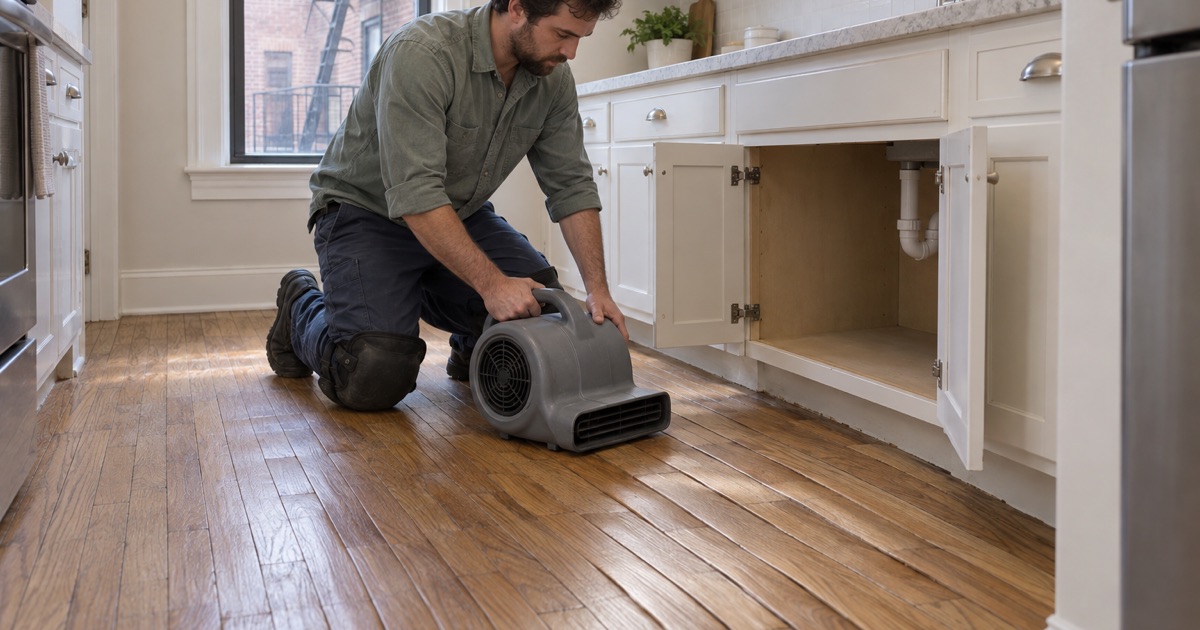
Drying may use fans, dehumidifiers or specialized drying mats. Your restoration company may handle that phase, and we coordinate our readings with theirs.
Dry and Sand, or Replace
Once the readings reach the target, the floor tells us what it needs. Boards that have flattened and are sound can be sanded and refinished. Boards that stay cupped, cracked, black-stained or soft are cut out and replaced with matching boards woven into the floor. Many jobs use both approaches in the same room.
Subfloor and Joist Checks
Water that soaked through a floor may have reached the plank subfloor or the floor joists. We check those from below where possible and by opening the floor at the worst spot when needed. Wet or rotted subfloor is replaced before new boards go in, since a new floor over a damaged base will fail.
Insurance Claims and Documentation
Room-by-Room Documentation for the Adjuster
We photograph the damage in each room, record moisture readings and their dates, note the species, board width and finish, and measure the affected area. The written scope lists which boards will be dried and sanded and which will be replaced, and why. That record helps your adjuster compare our estimate line by line.
Matching and Refinishing the Rest of the Floor
A repair in one room often cannot match a connected floor without refinishing the whole run. Whether a policy pays for that depends on its wording, since Massachusetts has no specific matching rule. We explain in writing why the connected area needs to be refinished so you can raise it with your adjuster.
Condo Master Policies and Deductibles
In condo buildings, the master policy may cover part of the floor damage, and how the deductible is split between the association and the unit owner is usually set in the condo documents rather than by statute. We price the repair clearly so the association and the owners can apply their own rules to it.
Our Step-by-Step Water Damage Repair Process
Step 1: Stop the Water and Assess
Once the leak is stopped, we inspect the floor, take moisture readings, photograph the damage and check the subfloor. Those first readings become the baseline for every later one.
Step 2: Dry and Monitor
The floor dries with the right equipment while we take repeated readings until they reach the target. Nothing is sanded or pulled while the numbers are still falling.
Step 3: Document for the Claim
We give you and your adjuster a written scope with photographs, readings and a line-by-line repair estimate. It separates boards to be dried and sanded from boards to be replaced.
Step 4: Repair Boards and Subfloor
Damaged boards and subfloor are replaced and matched wood is woven into the floor. Sound boards that dried flat stay in place.
Step 5: Sand and Refinish
The floor is sanded and refinished so the repaired area blends with the rest. You get a cure schedule for when rooms can be used again.
- 20+ Years on Wood Floors
- Free In-Home Estimates
- Dust-Contained Sanding